
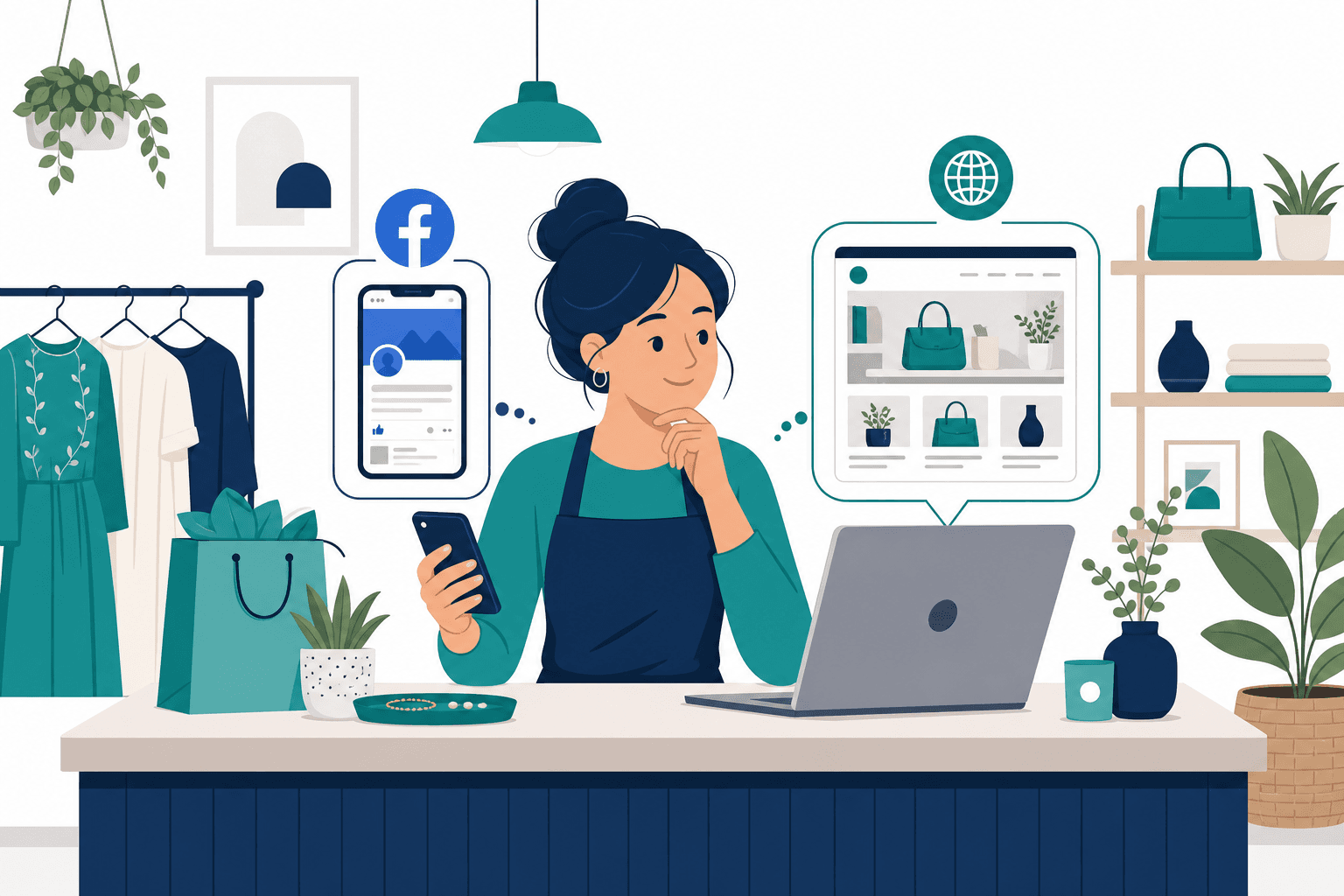
Plenty of local shops run their entire online presence on a Facebook or Instagram page. It's free, it's familiar, and it feels like enough.
For a while, it works. But relying only on social media quietly holds your shop back in ways that are easy to miss, until a competitor with a real website starts winning the customers you should be getting.
Here's why every local shop needs more than a Facebook page.
First, social media isn't bad, it's just not enough
Let's be fair. A Facebook or Instagram page is genuinely useful. It's great for:
- Posting updates and news
- Showing your personality
- Chatting with regulars
- Sharing photos and promotions
Keep doing all of that. The problem isn't using social media. The problem is using it instead of a website, because there are important jobs it simply can't do.
Problem 1: You don't own it
This is the big one. Your Facebook page isn't really yours, it's Facebook's. And that puts you at their mercy:
- They can change the rules any time (and they do).
- They can limit who sees your posts (and push you to pay to reach your own followers).
- They could suspend or lose your page, taking your whole presence with it.
It's like running your shop in a building you don't own, where the landlord can change the locks or the rent whenever they like. A website is a home base you actually control.
Problem 2: People search Google, not just Facebook
When someone needs a shop like yours, they usually search Google, "gift shop near me," "[your town] hardware store." And a Facebook page alone often doesn't show up well there.
A real website is what helps you appear in those Google searches. Without one, you're invisible to all the customers who look the normal way, which is most of them.
Problem 3: It looks less established
Fair or not, customers quietly judge. A business with only a Facebook page can come across as smaller or less serious than one with a proper website.
A real website signals "this is an established, legitimate business." For a shop trying to compete and grow, that impression matters more than you'd think.
Problem 4: You can't control the experience
On Facebook, your shop looks like every other Facebook page. Same layout, same buttons, your branding squeezed into their template, surrounded by ads and distractions, including, sometimes, your competitors' ads right next to your page.
On your own website, you control everything: how it looks, what people see first, and where their attention goes. No distractions, no competitors, just your shop putting its best foot forward.
Problem 5: It's hard for customers to find what they need
Facebook isn't built to be a shop's information hub. Customers struggle to quickly find your:
- Hours
- Location and directions
- Full product range
- Contact details
On a website, all of that is organized and instant. On a Facebook page, it's buried under posts or missing entirely, and a frustrated customer is a lost one.
The good news: you don't have to choose
Here's the key point. It's not website or social media. The smart shops use both, together:
- Social media for personality, updates, and chatting with your community
- Your website as the professional home base that gets you found, builds trust, and gives customers everything they need
Think of social media as a lively conversation at the market, and your website as the actual shop people walk into. You want both, each doing what it does best.
The bottom line
- A Facebook page is useful but not enough on its own.
- You don't own it, Facebook controls the rules, your reach, and your page's fate.
- A website helps you show up on Google, look established, control the experience, and give customers everything they need, fast.
- The answer isn't either/or, use both, with your website as the home base you actually own.
Your Facebook page is a great way to stay social. But a real website is how your shop gets found, gets trusted, and gets chosen. Don't build your business on rented land alone.
Bizy Site builds professional websites for local shops, the home base you own, found on Google and built to win customers, on a simple monthly plan with no upfront cost. See how it works →